How Sales Enablement AI Drives Real Adoption of Your Sales Playbook
Learn why sales playbook adoption fails, how Sales Enablement AI reinforces execution in real time, and practical ways to operationalize your enablement strategy.
February 23, 2026 - Laurie Bach
How Sales Enablement AI Drives Real Adoption of Your Sales Playbook
In many companies, the Sales playbook is a beautifully designed document... that sales reps rarely open.
Despite months of work defining messaging, qualification frameworks, objection handling, and processes, adoption remains inconsistent. Reps revert to old habits. Managers coach differently. New hires struggle to internalize the methodology.
This is where Sales Enablement AI becomes a game changer.
Instead of asking reps to remember the playbook, AI brings the playbook into their daily workflow turning strategy into execution.
In this article, we'll explore:
- Why playbook adoption fails
- How Sales Enablement AI improves adoption
- Practical use cases you can implement immediately
- How tools like Toocan help operationalize your enablement strategy
Why Sales Playbook Adoption Is So Hard
Sales Enablement leaders typically face four recurring challenges:
1. Information overload
Reps are trained once, then expected to memorize positioning, discovery questions, personas, objection handling, and processes.
2. Lack of reinforcement
Training sessions are event-based. But behavior change requires repetition and in-context reinforcement.
3. Inconsistent coaching
Managers interpret the playbook differently, leading to variations in execution.
4. No real-time guidance
The playbook lives in Notion, Google Drive, or a PDF. But sales conversations happen in real time.
The result? Partial adoption.
What Is Sales Enablement AI?
Sales Enablement AI refers to AI systems trained on your company's internal knowledge (playbooks, messaging, frameworks, case studies, objection handling, etc.) and integrated directly into the sales workflow.
Instead of being another tool, it becomes a real-time assistant that:
- Answers reps' questions instantly
- Suggests relevant talk tracks
- Surfaces the right objection-handling framework
- Reinforces qualification criteria
- Guides process compliance
In short: it operationalizes your enablement strategy.
5 Practical Ways Sales Enablement AI Improves Playbook Adoption
1. Real-Time Objection Handling
Instead of expecting reps to memorize every objection response, AI can:
- Detect objections during live calls
- Suggest structured responses (e.g., 3F method, SPIN-based reframing)
- Pull relevant case studies or proof points
This reduces stress for reps and ensures consistency in messaging.
2. Embedded Discovery Frameworks
Reps often forget to follow structured qualification methods.
Sales Enablement AI can:
- Surface recommended discovery questions based on persona
- Remind reps of qualification criteria (e.g., MEDDICC elements)
- Highlight missing information before moving deals forward
This drives better pipeline quality without relying only on manager coaching.
3. Faster Onboarding and Ramp-Up
New hires struggle most with:
- Product knowledge
- Positioning nuances
- Competitive comparisons
- Process steps
Instead of searching through documentation, they can ask:
"How do we position against competitor X?"
"What's our discovery structure for CFO personas?"
AI provides instant, accurate answers sourced from your official playbook accelerating ramp-up while reducing dependency on managers.
4. Reinforcing Process Compliance
Sales Enablement leaders often struggle to ensure:
- Proper CRM updates
- Correct qualification stages
- Standardized follow-up emails
- Structured call summaries
AI can:
- Suggest standardized recap emails
- Prompt next-step recommendations
- Check whether required qualification elements are covered
This ensures the playbook isn't optional it becomes the default behavior.
5. Continuous Learning Loop
One of the most powerful aspects of Sales Enablement AI is feedback collection.
You can analyze:
- What reps ask the AI most often
- Which objections create the most friction
- Where clarification is frequently requested
This gives Sales Enablement real data on:
- Where the playbook lacks clarity
- What training topics need reinforcement
- Which messaging sections require simplification
AI doesn't just distribute knowledge it helps you improve it.
How to Implement Sales Enablement AI (Action Plan)
If you lead Sales Enablement, here's a practical roadmap:
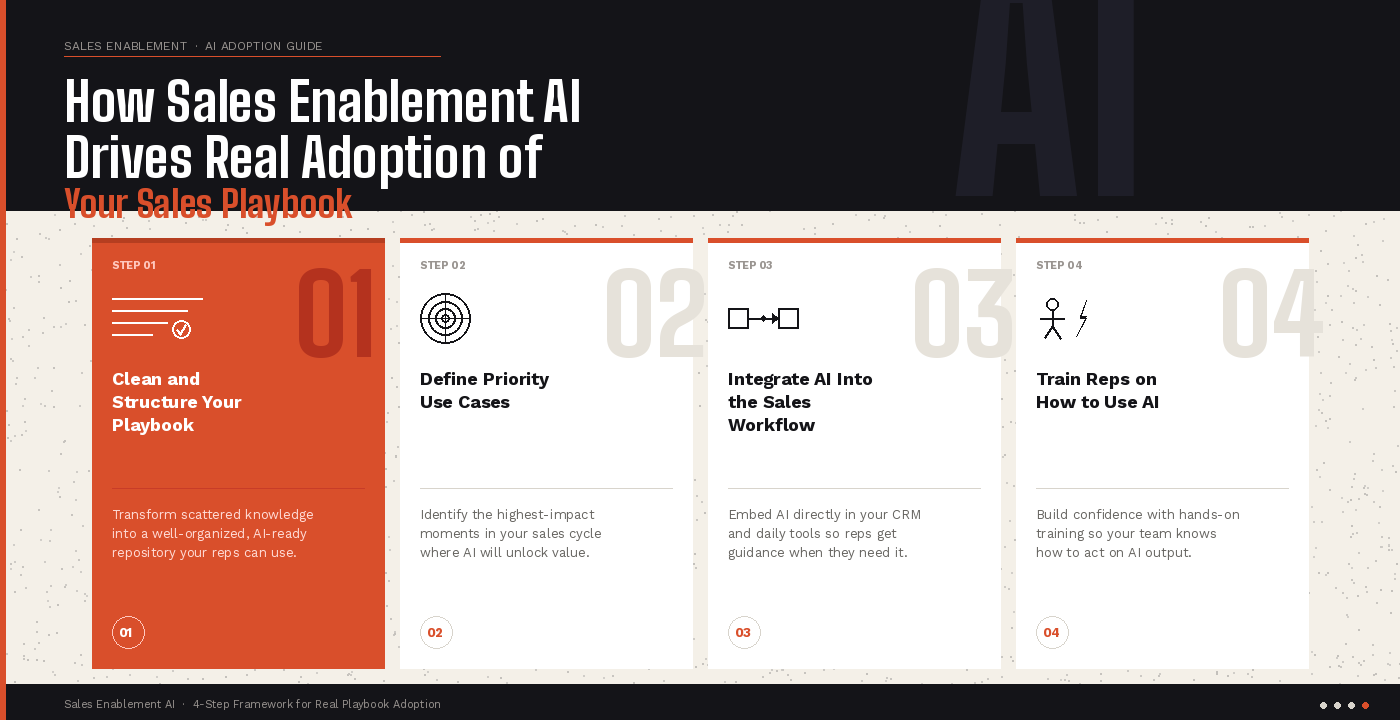
Step 1: Clean and Structure Your Playbook
Before AI can help, your knowledge base must be:
- Centralized
- Structured
- Updated
- Clear and actionable
AI amplifies clarity it doesn't fix chaos.
Step 2: Define Priority Use Cases
Start with high-impact friction points:
- Objection handling
- Discovery frameworks
- Competitive positioning
- Email templates
- Process compliance
Avoid trying to "AI everything" at once.
Step 3: Integrate AI Into the Sales Workflow
Adoption depends on integration.
The AI must live:
- Inside your CRM
- Inside your call tool
- As a browser extension
- Within your knowledge base environment
If reps need to open a separate tab, adoption will drop.
Step 4: Train Reps on How to Use AI (Yes, That Too)
Sales Enablement AI is not self-adopted.
You must:
- Define clear use cases
- Set guidelines
- Share examples
- Show how it reinforces the playbook
Position it as a performance tool not a monitoring tool.
How Toocan Helps Sales Enablement Teams Drive Adoption
Toocan is built specifically to operationalize Sales Enablement strategy.
Unlike generic AI assistants, Toocan:
- Connects to your internal knowledge base (Notion, Drive, etc.)
- Understands your sales playbook and frameworks
- Integrates into sales conversations
- Provides real-time, context-aware answers
- Reinforces your defined methodology
Instead of asking reps to remember the playbook, Toocan brings it directly into their workflow.
For Sales Enablement leaders, this means:
- Faster onboarding
- Consistent messaging
- Better objection handling
- Higher process compliance
- Data-driven insights on knowledge gaps
Most importantly: your playbook becomes a living system not a static document.
The Future of Sales Enablement AI
Sales Enablement is evolving from:
- Creating content
- Delivering training
- Running workshops
To:
- Embedding guidance directly into execution
- Using AI to reinforce behavior daily
- Measuring adoption through usage and interaction data
The question is no longer "Did we train the team?"
It's:
"Is our playbook actively guiding conversations every day?"
Sales Enablement AI makes that possible.
Final Thoughts
If you're responsible for Sales Enablement, you don't just want a great playbook.
You want:
- Consistent execution
- Faster ramp-up
- Higher win rates
- Better pipeline quality
AI is not replacing Sales Enablement.
It's finally giving it leverage.
And when implemented correctly, Sales Enablement AI turns strategy into daily behavior at scale.